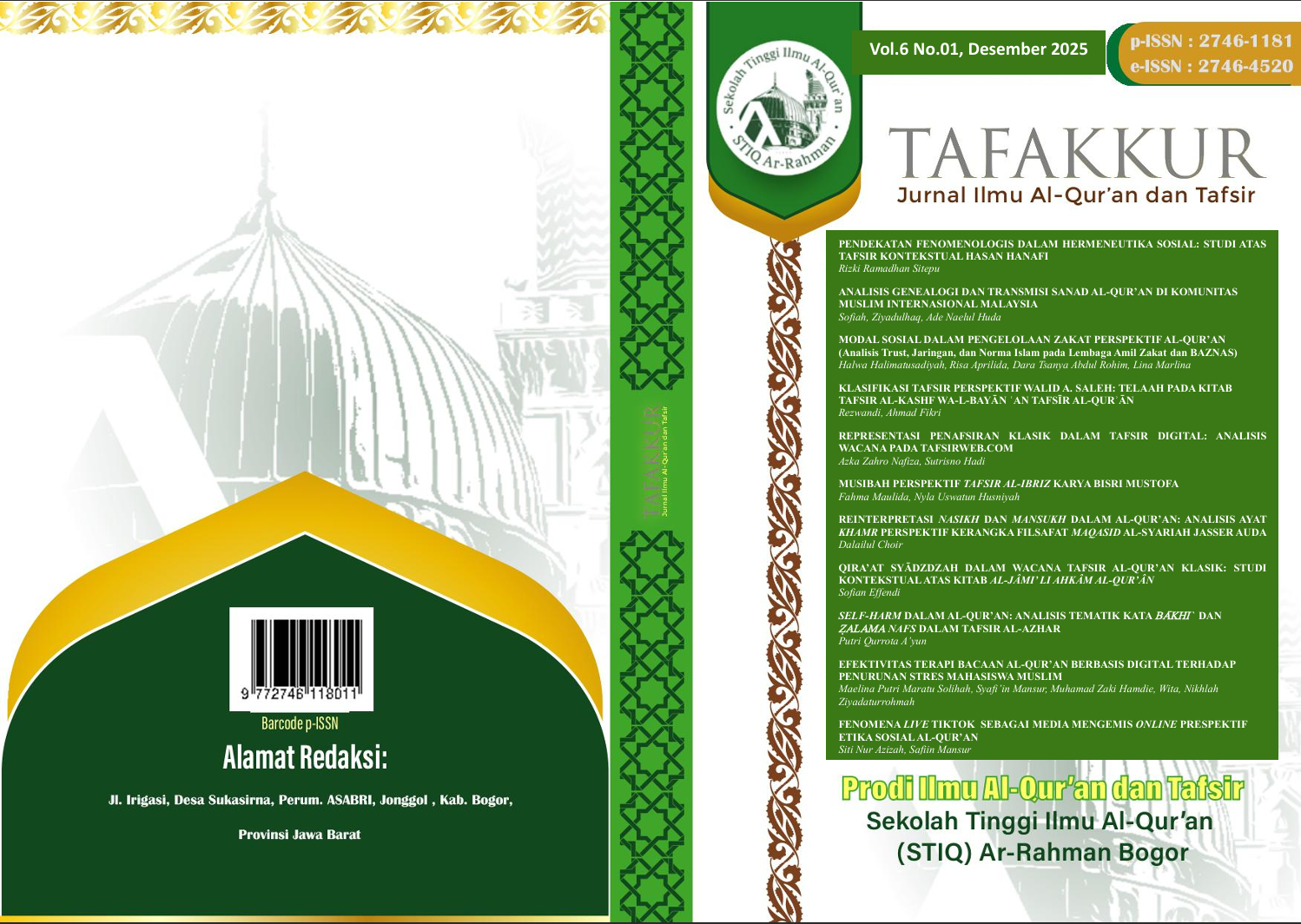
MODAL SOSIAL DALAM PENGELOLAAN ZAKAT PERSPEKTIF AL-QUR’AN
Analisis Trust, Jaringan, dan Norma Islam pada Lembaga Amil Zakat dan BAZNAS
DOI:
https://doi.org/10.62359/tafakkur.v6i01.789Keywords:
Al-Qur’an, Islamic norms, social capital, zakatAbstract
Zakāt is a crucial element in Islam due to its spiritual and socio-economic roles. This study aims to analyze the effectiveness of zakāt management at zakāt monitoring institutions (LAZ) and BAZNAS, focusing on social capital, particularly trust and networks, along with the role of Islamic principles. The research will involve examining academic articles, books, and official publications regarding zakāt and social capital, conducting literature reviews and document analyses. The findings reveal that trust is a major factor influencing the success of zakāt distribution and collection among transparent organizations. Furthermore, social networks that include institutions, local communities, and government bodies enhance the scope of zakāt distribution and promote the empowerment of muzakkī (donors). Islamic principles ensure that zakāt is managed effectively and ethically, in accordance with sharīa (Islamic law). As a result, enhanced trust, networks, and the application of Islamic principles strengthen the integrity of the zakāt system, increasing muzakkī engagement and effectively reducing social inequalities.
Downloads
References
Abdul Wahid al-Faizin dan Nashr Akbar, Tafsir Ekonomi Kontemporer: Menggali Teori Ekonomi dari Ayat-Ayat Al-Qur'an (Jakarta: Gema Insani, 2018), 188–189.
Alam, A., Ratnasari, R. T., Ryandono, M. N. H., Prasetyo, A., & Rahmawati, E. “Trust Studies of Zakat Institutions: A Systematic Review for Future Research Direction.” International Journal of Emerging Issues in Islamic Studies, Vol.3 No.2 (2023).
Assa’diyah, H., & pranomo, S. (2019). Kenapa Muzzaki Percaya Kepada Lembaga Amil Zakat? Jurnal Akuntansi Dan Keuangan Islam, 7(1), 81-100. https://doi.org/10.35836/jakis.v7i1.68
Fadilah, S. (2011). Analisis Penerapan Good Corporate Governance Terhadap Kinerja Organisasi Melalui Kepercayaan Konsumen. Jurnal Akuntansi Riset, Prodi Akuntansi, 03(02), 637–651.
Febriandika, N. R., Kusuma, D. G., & Yayuli “Zakat compliance behavior in formal zakat institutions: An integration model of religiosity, trust, credibility, and accountability.” International Journal of Advanced and Applied Sciences, 10(6): 187-194 (2023).
Francis Fukuyama, Social Capital and Civil Society, IMF Working Paper WP/00/74, 2000
Fukuyama, Francis. Trust: The Social Virtues and the Creation of Prosperity. New York: Free Press, 1995. (Sumber utama konsep modal sosial).
Halimah, N., & Zak, I. (2020). Pengelolaan Modal Sosial Dalam Meningkatkan Kesejahteraan Masyarakat (Studi Kasus Baitul Maal Hidayatullah Surabaya). Jurnal Ekonomi Syariah Teori Dan Terapan, 7(5), 842–851. https://doi.org/10.20473/vol7iss20 205pp842-851 Jakarta: PT. Damar Mulia Rahayu.
Hotimah, H., & Suprayogi, N. “Meta-Analysis Study: The Effects of Accountability and Transparency on Muzaki’s Trust in Zakat Institutions in Indonesia.” ZISWAF: Jurnal Zakat dan Wakaf, Vol.4 No.2 (2023).
Jannah, M., Wulandari, N., & Hasibuan, S. R. (2021). Nilai-Nilai Pendidikan Akhlak Dalam Al-Quran: Kajian Tafsir Surat Al-Hujurat Ayat 9-13. Tarbiyah Islamiyah: Jurnal Ilmiah Pendidikan Agama Islam, 11(2), 113–124. https://doi.org/10.18592/jtipai.v11i2.4910
Mu’min, M. D. N. A., Hasob, H. A. A., Abubakar, A., Basri, H., & FazakaRif’ah, M. A. (2024). Telaah hubungan sosial dalam Al-Quran : studi tafsir QS. Al-Hujurat ayat 10. Journal of Management and Innovation Entrepreunership (JMIE), 1(2), 338-350. http://ejournal.stitta.ac.id/index.php/ambarsa/article/view/174/140
Muh Dian Nur Alim Mu’minin, dkk., "Telaah Hubungan Sosial dalam Al-Quran: Studi Tafsir QS. Al-Hujurat Ayat 10," Journal of Management and Innovation Entrepreneurship (JMIE) 1, no. 1 (Januari 2024): 339–340.
Mukhlishin, et al. “Zakat Maal Management and Regulation Practices.” Jurnal Human Rights, Culture and Legal System (2024).
Nasim, A., & Romdhon, M. R. S. (2014). Pengaruh Transparansi Laporan Keuangan, Pengelolaan Zakat, dan Sikap Pengelola Terhadap Tingkat Kepercayaan Muzakki. Jurnal Riset Akuntansi Dan Keuangan, 2(3), 550–561.
Pierre Bourdieu, The Forms of Capital dalam J. Richardson, ed. Handbook of Theory and Research for The Sociology of Education, Westport, CT:Greenwood Press,
1980.
Putnam, Robert dengan Robert Leonardi dan Rafaella Nanetti, 1993. Making Democracy Work: Civic Traditions in Modern Italy, Princeton, N.J.: Princeton University Press.
Robbani, A. A. “Are Zakat Institutions Trusted To Accept Charity?” Journal of Economics, Finance and Accounting Studies, Vol.4 No.2 (2022).
Safrizal. (2015). Pengaruh Akuntabilitas dan Transparansi Lembaga Zakat Terhadap Tingkat Kepercayaan Muzakki dan Dampaknya Pada Keinginan Membayar Zakat di Baitul Mal Kabupaten Aceh. Thesis. Universitas Syiah Kuala Bandar Darussalam
Sanusi, I. (2016). Networking Badan Amil Zakat Nasional Jawa Barat dalam Meningkatkan Pelayanan Zakat. Ilmu Dakwah: Academic Journal for Homiletic Studies, 10(1), 79-96.
Sutojo, S., & Aldiridge, E. J. (2005). Good Corporate Governance : Tata Kelola Perusahaan yang Sehat.
Takidah, E., & Pratiwi, A. “Governance and Trust in Zakat Institution.”
Downloads
Published
How to Cite
Issue
Section
License
Copyright (c) 2025 Halwa Halimatusadiyah, Risa Aprilida, Dara Tsanya Abdul Rohim, Lina Marlina

This work is licensed under a Creative Commons Attribution-ShareAlike 4.0 International License.
This work is licensed under a Creative Commons Attribution-ShareAlike 4.0 International License.